Scan any baby food by photo or barcode. The scanner automatically cross-checks every ingredient against your baby's tracked allergen history and the latest FDA recall feed, using AI to read labels in any language and identify homemade food - in seconds, before you open the pouch.
AI this powerful should protect every child, not just the ones who can pay. Safety isn't a premium feature - it's the whole point.
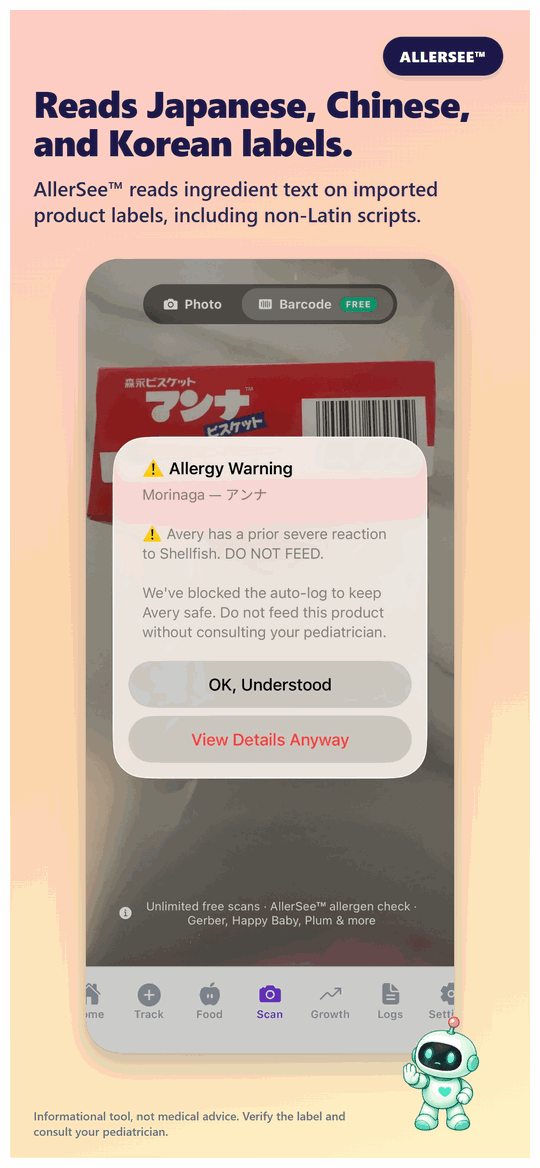
The AllerSee scanner is Baby Ledger AI's allergen safety layer. It runs automatically on every barcode scan and every AI photo scan, on every subscription tier, free of charge and without scan limits. It pairs a deterministic product-database cross-check with AI vision that reads labels in any language and recognizes homemade food, reconciling several independent data sources into a single per-baby advisory the parent sees before logging the food.
For packaged products, the AllerSee scanner reads the UPC/EAN barcode and resolves the product against a 3+ million-item ingredient database (Open Food Facts plus internal augmentation for U.S. baby-food SKUs).
For homemade or unpackaged food, the scanner uses an AI vision model to identify the dish and infer its likely ingredient list, then runs the same allergen reconciliation against your baby's ledger.
The system reconciles the identified ingredients against the active baby's parent-entered allergen ledger. Each ledger entry carries a parent-recorded severity level and a date of last exposure. Households with multiple children maintain a separate ledger per child.
When a high-severity match is detected, the AllerSee scanner surfaces a blocking modal that prevents auto-logging and displays a hard-block alert reading "DO NOT FEED" for that baby. Lower-severity matches surface a non-blocking advisory. In all cases the parent retains a "View Details Anyway" path so the advisory is informational and never overrides parental judgment.
In parallel with the allergen check, every barcode scan is cross-checked against the active U.S. FDA food-recall feed, refreshed daily. Class I recalls (FDA's most-serious classification) are flagged with a distinct red advisory. Recall data lags official FDA publication and should not be relied on as a sole source for time-critical recall awareness.
In the founder's own words, from the build notes:
The AllerSee™ scanner is the allergen label scanner built into Baby Ledger AI. The design decision I care about most in it isn't a feature you can see in a screenshot. It's what the scanner does when it has no data, because for a safety tool, "what do you do when the data is empty" is the whole game.
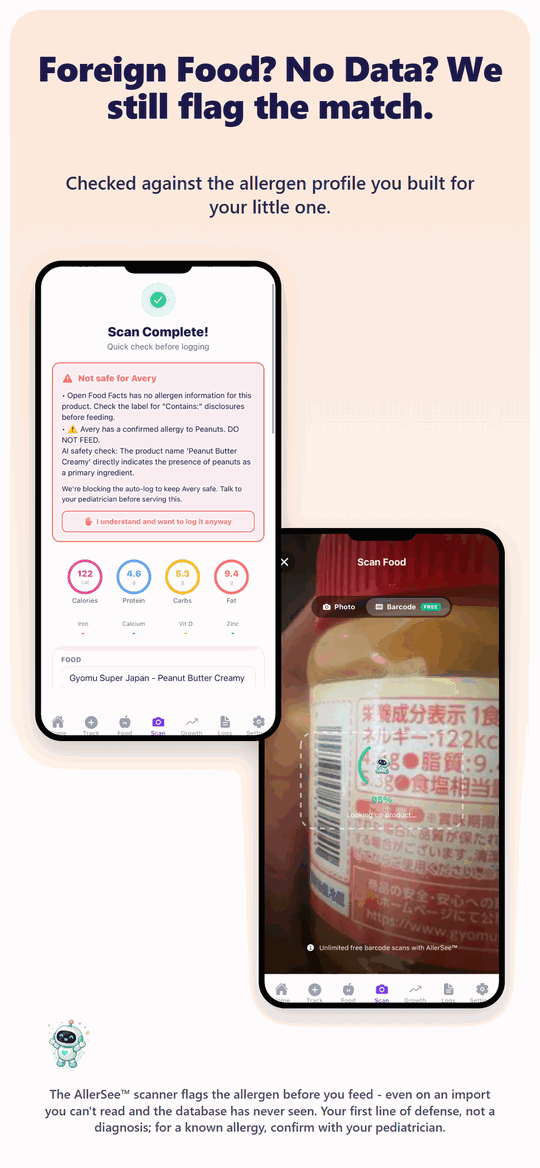
Most barcode allergen scanners do the efficient thing: look up the product, read the ingredient list, and check it against the allergens you care about. That's fine when the product is in the database. But scan an imported product the database has never seen, and a lot of scanners just return "no allergens found" and stop. That's a silent failure. "No data" renders on screen exactly like "safe," when the truth is the tool has no idea. For an allergy parent, the dangerous moment isn't when the database is full - it's when it's empty.
So the scanner is built to get more careful, not less, exactly when the data is thin. An empty or unreadable record is treated as a reason to look harder - including reading label text across several languages - never as an all-clear. It leans toward telling you "double-check this" over "looks fine." It can over-flag, and honestly I'd rather it do that than stay quiet. "No data" is never shown as "no allergens" - if it can't read something, it says so.
The scan that proved the point out: an imported product returned zero ingredient data from the open product database we pull from (Open Food Facts, over 3 million products). Instead of a green check, the scanner flagged peanut against a profile that had peanut set as an allergen, and threw a hard "do not feed" block. To be honest, the product name literally said peanut butter, so a careful human catches this one too - the point isn't that it's clever, it's that it refused to fake confidence on missing data instead of returning "no allergens found."
Yes - the allergen cross-check, barcode scanning, and FDA recall check are free and unlimited on every plan, no credit card to start. Only the AI photo scans and Saurus questions have daily limits on Free.
It reads ingredient labels across English, Japanese, Chinese, Korean, German, and Cyrillic (the app interface is in English) - so an imported jar you can't read gets the same allergen cross-check as everything else.
It won't just call it safe. A missing or unreadable record is treated as a reason to look harder, not a green light - at worst it over-flags and prompts you to re-read the label.
No. It's an informational tool - a first check for allergens, not a diagnosis. False negatives are possible. Always read the full label and talk to your pediatrician.
Every barcode is checked against active FDA recalls - a match triggers a red blocking alert before you log the food. It's the FDA feed specifically, so treat it as one more check, not full recall coverage.
The profile you build for your baby - you set each allergen and its severity, and confirmed allergies block the scan. It only knows what you tell it.

The AllerSee scanner is included on every Baby Ledger AI plan, including Free, with no scan limits. No credit card. No trial countdown.
📲 Download on the App Store