 Baby Ledger AI
Most allergen apps work in English only. Travel home with a Japanese baby food jar, a Korean rice puff, or a Chinese tofu pouch and they often fail silently. The AllerSee™ scanner built into Baby Ledger AI was built for the parents who don't only shop the U.S. supermarket aisle: it reads ingredient labels in English plus five additional writing systems (Japanese, Chinese, Korean, Cyrillic, and German) and cross-checks what it reads against the allergen profile you build for your child (the app interface is in English).
Imported products are exactly where a lot of scanning tools fall down. A product sold only in Japan, or stocked in a single Asian or Latin grocery, often has no entry at all in the big open product databases that most barcode apps rely on - and a database gap is very different from a clean result. When the data is thin, the AllerSee scanner is built to get more careful, not less: an empty or unreadable record is treated as a reason to look harder, never as an all-clear.
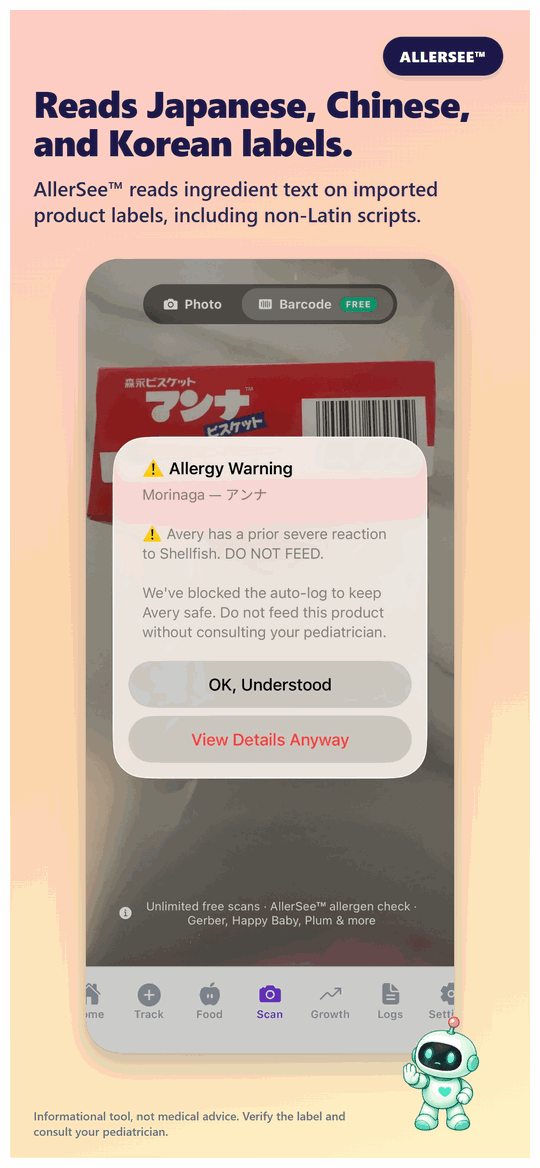
Which languages and label types does it read?
The AllerSee scanner's product database draws from Open Food Facts, which covers imported baby foods from 200+ countries with allergen tags normalized to a single English vocabulary. The cross-check against your baby's tracked allergen ledger works the same whether the package label is in English, Japanese, Chinese, Korean, German, or Cyrillic - because the allergen reconciliation runs against the normalized tag, not the on-package text. For barcode scans of products in our database, the language printed on the package doesn't affect detection. For products not yet in the database (homemade food, unpackaged items, very new SKUs), the scanner's AI vision can read non-Latin labels, though we recommend barcode scanning whenever available for highest reliability.
Label-reading (OCR) is strongest for English, Japanese, Chinese, and Korean. For packaged products in our database, allergen detection works regardless of label language because the cross-check runs against normalized ingredient tags. Detection depends on product-database coverage and accurate label parsing; always verify the package label.
Product ingredient and allergen data is sourced in part from the Open Food Facts database, which is licensed under the Open Database License (ODbL) v1.0.
Go deeper: language-specific label guides
Each import market handles allergen disclosure differently - different scripts, different mandatory lists, different "may contain" conventions. These guides break each one down:
The honest limits
To be clear about the limits, because they matter for an allergy tool: false negatives are still possible, AllerSee is an awareness and label-reading aid, not a medical device, and it never replaces reading the full label or talking to your pediatrician. When the product database has nothing, it gets more cautious instead of waving the product through - but "more cautious" is not the same as "catches everything," and it never will be.
AllerSee™ specifics: the AllerSee scanner is a safety aid, not a substitute for the package label or for medical advice. Detection depends on product-database coverage and the allergen profile you enter. Ingredient databases, multilingual parsing, and AI detection may be incomplete, outdated, mistranslated, or inaccurate.
Frequently asked questions
What languages can it read?
It reads ingredient labels across English, Japanese, Chinese, Korean, German, and Cyrillic (the app interface is in English) - so an imported jar you can't read gets the same allergen cross-check as everything else.
What happens when a product isn't in the database?
It won't just call it safe. A missing or unreadable record is treated as a reason to look harder, not a green light - at worst it over-flags and prompts you to re-read the label.
Is it a medical device?
No. It's an informational tool - a first check for allergens, not a diagnosis. False negatives are possible. Always read the full label and talk to your pediatrician.
Does it check recalls?
Every barcode is checked against active FDA recalls - a match triggers a red blocking alert before you log the food. It's the FDA feed specifically, so treat it as one more check, not full recall coverage.