Scan any baby food by photo or barcode. The scanner automatically cross-checks every ingredient against your baby's tracked allergen history and the latest FDA recall feed, using AI to read labels in any language and identify homemade food - in seconds, before you open the pouch.
AI this powerful should protect every child, not just the ones who can pay. Safety isn't a premium feature - it's the whole point.
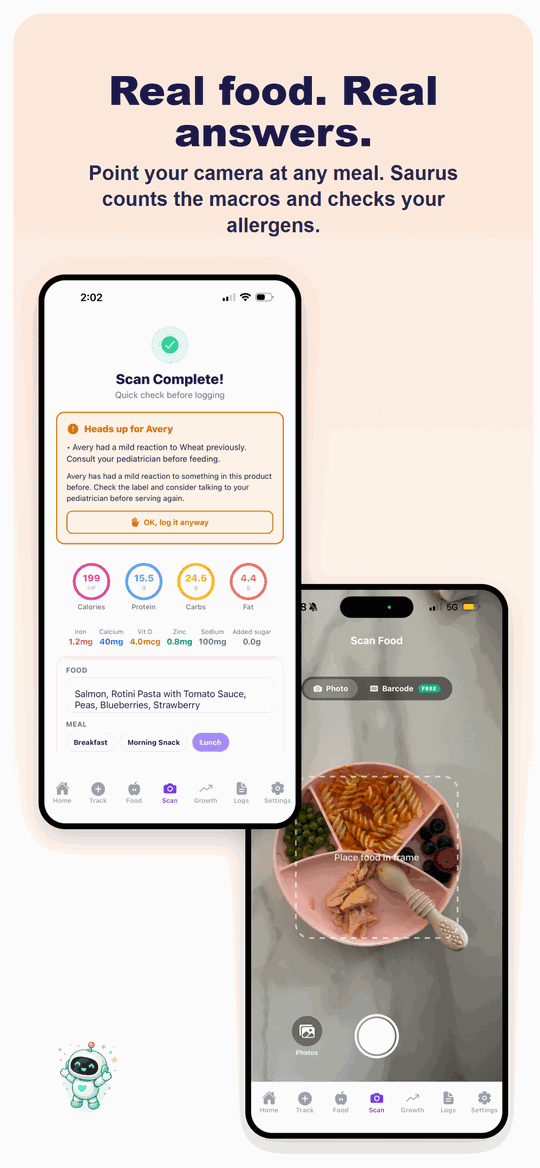
The AllerSee scanner is Baby Ledger AI's allergen safety layer. It runs automatically on every barcode scan and every AI photo scan, on every subscription tier, free of charge and without scan limits. It pairs a deterministic product-database cross-check with AI vision that reads labels in any language and recognizes homemade food, reconciling several independent data sources into a single per-baby advisory the parent sees before logging the food.
For packaged products, the AllerSee scanner reads the UPC/EAN barcode and resolves the product against a 3+ million-item ingredient database (Open Food Facts plus internal augmentation for U.S. baby-food SKUs). For homemade or unpackaged food, the scanner uses an AI vision model to identify the dish and infer its likely ingredient list, then runs the same allergen reconciliation against your baby's ledger.
The AllerSee scanner's product database draws from Open Food Facts, which covers imported baby foods from 200+ countries with allergen tags normalized to a single English vocabulary. The cross-check against your baby's tracked allergen ledger works the same whether the package label is in English, Japanese, Chinese, Korean, German, or Cyrillic - because the allergen reconciliation runs against the normalized tag, not the on-package text. For barcode scans of products in our database, the language printed on the package doesn't affect detection. For products not yet in the database (homemade food, unpackaged items, very new SKUs), the scanner's AI vision can read non-Latin labels, though we recommend barcode scanning whenever available for highest reliability.
The system reconciles the identified ingredients against the active baby's parent-entered allergen ledger. Each ledger entry carries a parent-recorded severity level and a date of last exposure. Households with multiple children maintain a separate ledger per child.
When a high-severity match is detected, the AllerSee scanner surfaces a blocking modal that prevents auto-logging and displays a hard-block alert reading "DO NOT FEED" for that baby. Lower-severity matches surface a non-blocking advisory. In all cases the parent retains a "View Details Anyway" path so the advisory is informational and never overrides parental judgment.
In parallel with the allergen check, every barcode scan is cross-checked against the U.S. FDA food-recall feed, refreshed daily. Class I recalls (FDA's most-serious classification) are flagged with a distinct red advisory. Recall data lags official FDA publication and should not be relied on as a sole source for time-critical recall awareness.
Allergen ledger entries and confirmed reactions sync in real time across everyone attached to the baby's profile. On Free you can add one read-only family viewer; Plus and Premium add write-access caregivers (partner, nanny, grandparents) who can log too, so a reaction one caregiver records is reflected the next time anyone opens the scanner, before the next feed.
Most allergen apps work in English only. Travel home with a Japanese baby food jar, a Korean rice puff, or a Chinese tofu pouch and they often fail silently. The AllerSee scanner was built for the parents who don't only shop the U.S. supermarket aisle. Label-reading (OCR) is strongest for English, Japanese, Chinese, and Korean. For packaged products in our database, allergen detection works regardless of label language because the cross-check runs against normalized ingredient tags. Detection depends on product-database coverage and accurate label parsing; always verify the package label.
The AllerSee scanner resolves products from a 3+ million-item database. Most well-known U.S. baby food brands are included out of the box, alongside international and store-brand products parents buy in real life.
Yes - the allergen cross-check, barcode scanning, and FDA recall check are free and unlimited on every plan, no credit card to start. Only the AI photo scans and Saurus questions have daily limits on Free.
It reads ingredient labels across English, Japanese, Chinese, Korean, German, and Cyrillic (the app interface is in English) - so an imported jar you can't read gets the same allergen cross-check as everything else.
It won't just call it safe. A missing or unreadable record is treated as a reason to look harder, not a green light - at worst it over-flags and prompts you to re-read the label.
No. It's an informational tool - a first check for allergens, not a diagnosis. False negatives are possible. Always read the full label and talk to your pediatrician.
Every barcode is checked against the latest FDA recall feed - a match triggers a red blocking alert before you log the food. It's the FDA feed specifically, so treat it as one more check, not full recall coverage.
The profile you build for your baby - you set each allergen and its severity, and confirmed allergies block the scan. It only knows what you tell it.

The AllerSee scanner is included on every Baby Ledger AI plan, including Free, with no scan limits. No credit card. No trial countdown.
📲 Download on the App Store